Conservation Status
Not threatened. Population decreasing.
Description
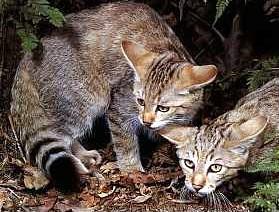
The wildcats of Central Asia differ from the European wildcats by having a more greyish-yellow or reddish background color, marked distinctly with small black or red-brown spots. The spots are sometimes fused into stripes, especially in the Central Asian regions east of the Tian Shan Mountains. They are frequently observed in the daytime.
Size
Unless your house cat is very petite, he/she outweighs an Asian Wildcat by a few pounds. Asiatic wildcats tend to be smaller in size, weighing between 3-4 kg, with females smaller than males.
Habitat
Asiatic wildcats are most typically found in scrub desert. They do not occur in the steppe grasslands of Mongolia and Inner Mongolia, nor in alpine steppe. They range up to 2,000-3,000 m in mountain areas with sufficient dense vegetation. Wildcats can be found near cultivated areas and human settlement. They usually occur in close proximity to water sources, but are also able to live year-round in waterless desert.
Diet
Like the other wildcats, rodents are the preferred prey: jerboas, gerbils, voles and mice. The diet also includes hares, young ungulates, birds, insects, lizards and snakes
Breeding
Litters of usually 2-3 (but as many as 6) are born after a gestation of 58-62 days.
Range
From the eastern Caspian into western India, and north to Kazakhstan, and into western China and southern Mongolia. The Caucasus is the transitional zone between the European wildcat (silvestris group) to the north and west, and the Asiatic wildcat to the south and east. In this region, European wildcats are found in mountain forest, and Asiatic wildcats are found in the low-lying desert and semi-desert areas adjoining the Caspian sea.
Other Names
Asian steppe wildcat, Indian desert cat (English)
chat sauvage d’Asie, chat orné (French)
Asiatische Wildkatze, Steppenkatze (German)
gato montés, gato silvestre (Spanish)
ye mao, caoyuan ban mao (Chinese)
psk dsty (Dari: Afghanistan)
chat sauvage d’Asie (French)
velis cata (Georgian)
myallen, sabancha, myshuk dala, jawa misik (Kazakh)
matsyl, zhapayi mishik (Kirgiz)
jhang meno (Kutch: India)
tsookhondoi (Mongolia)
gorbeh vahhshi (Farsi, Iran)
Asiaskiya dkikaya stepnaya koshka, dlinahvostaya koshka, pyatnistaya koshka (Russian)
yawa müshük (Uygur)
choi pshak, sabancha, yobai pshak (Uzbek)
|
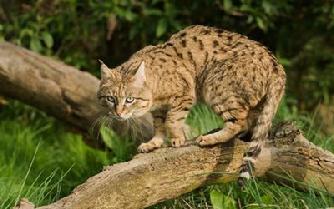 |
| Asiatic Wildcat (Felis silvestris ornata) |
|
|